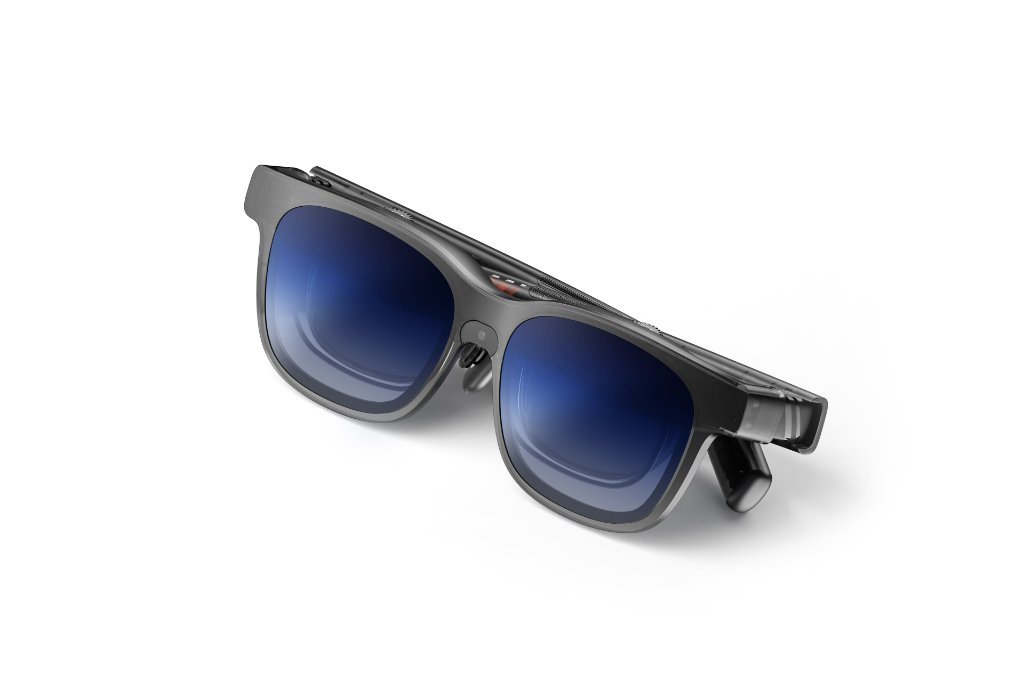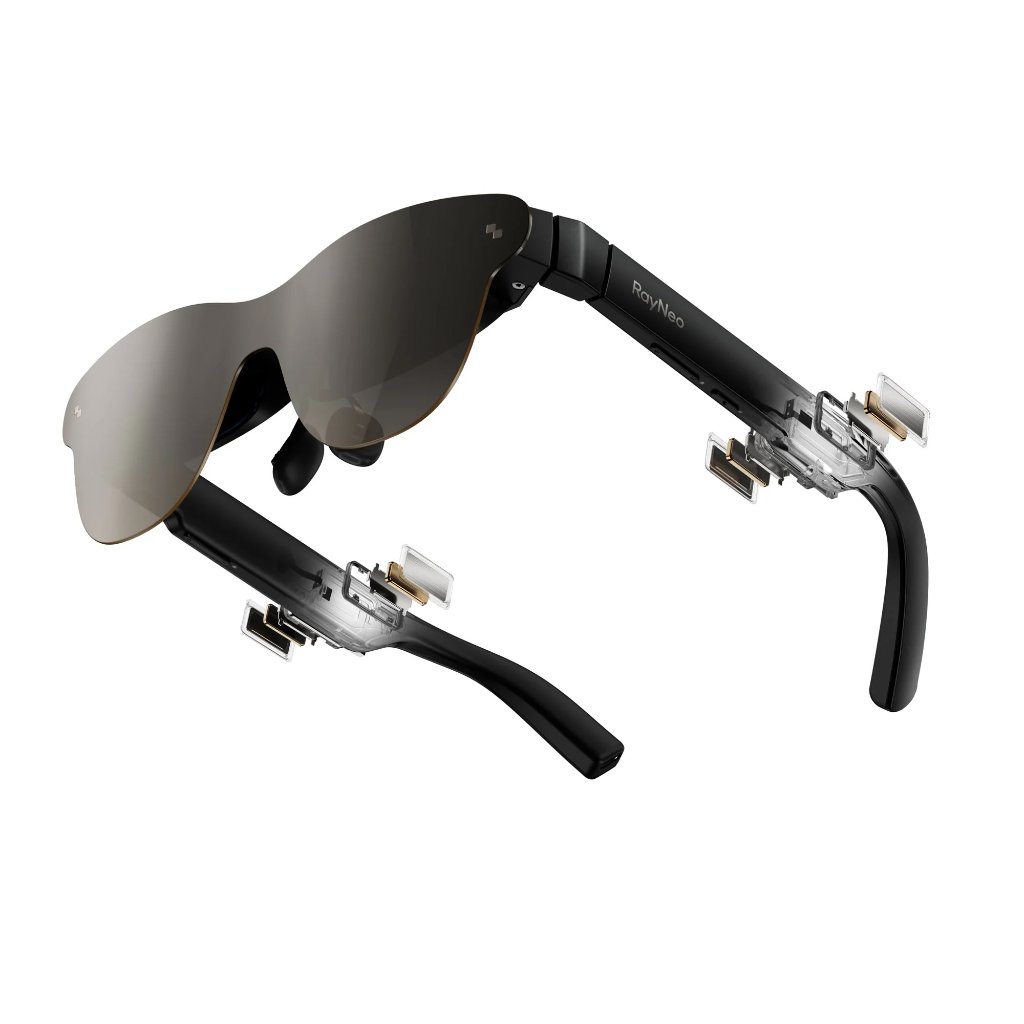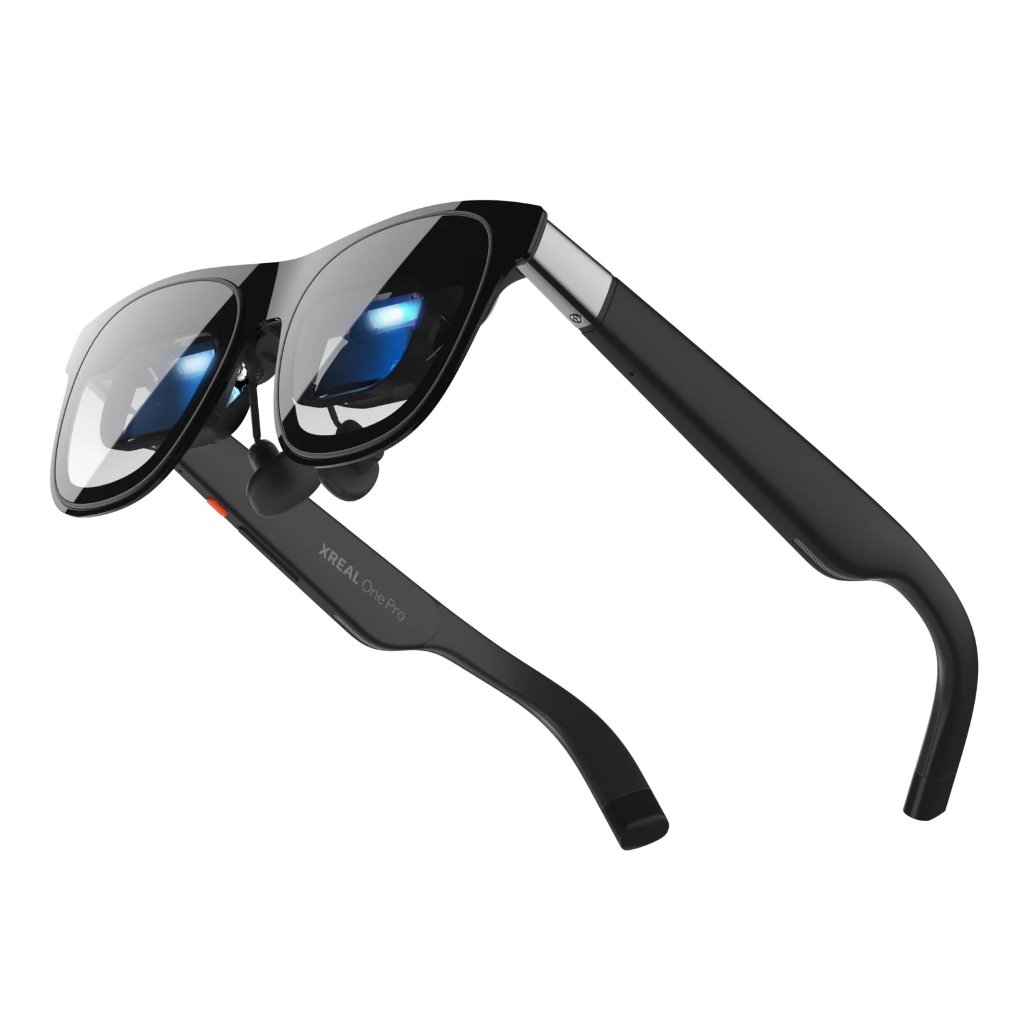
XReal One Pro
Next-generation AR glasses with X1 spatial computing chip, 171-inch equivalent 120Hz display, and premium Bose audio.
Add prescription lenses (+£50)
- Industry-leading 120Hz Sony Micro-OLED displays
- X1 chip enables advanced spatial computing
- Premium Bose audio integration
- Wide IPD adjustment range (57-66mm)
- 3DoF tracking for immersive experiences
Free UK delivery • 30-day returns • Expert optical support
What is the XReal One Pro?
A premium overview from The Smart Glasses Store
What it is
The XReal One Pro is a wearable AR display glasses system — not a standalone device, and not a VR headset. Think of it as a wearable screen: connect it to your phone, laptop, tablet, or gaming console via USB-C, and it projects a large, crisp virtual display that fills your vision. The XReal uses Sony Micro-OLED panels — the same premium display technology found in high-end Sony professional equipment — to create a viewing experience equivalent to a 201-inch screen at a comfortable distance. These are designed for immersive media viewing, travel entertainment, gaming, and portable productivity. They are not designed to overlay digital information on the real world in the traditional "AR" sense — they are a wearable display system.
Who it's designed for
The XReal One Pro is designed for travellers, commuters, gamers, and media consumers who want a large, private, high-quality screen in a portable form factor. If you watch films on planes and find phone screens too small, if you play portable games and want a large display without a heavy monitor, or if you need a private screen in shared spaces — this is designed for you. It is equally compelling as a productivity tool: connected to a laptop, it becomes a large virtual monitor for focused work.
What makes the XReal stand out
The defining feature of the XReal One Pro within the AR display glasses category is the Sony Micro-OLED display specification. At 1800 nits peak brightness, it is one of the brightest consumer AR glasses available — significantly exceeding most competitors which typically range from 400 to 600 nits. The electrochromic dimming lens tint, which can be adjusted electronically, adds meaningful real-world practicality: by reducing ambient light intrusion, it improves display contrast in brighter environments. These two features together set the XReal One Pro apart from most alternatives at this price point.
How to use it day-to-day
In practice, using the XReal One Pro means connecting them via USB-C to your chosen device before putting them on. They power immediately — no boot sequence, no pairing, no app required. You put them on and the display appears. For travel: connect to your phone and watch films without a phone screen. For gaming: connect to a Steam Deck, gaming laptop, or HDMI adapter for a large-screen gaming experience. For work: connect to your laptop for a private, large virtual display. When you disconnect the cable, the display off. The experience is deliberately simple.
How it differs from VR and standalone AR
It is important to understand what these are — and what they are not. The XReal One Pro is not a standalone AR headset with built-in processing (like Meta Quest or Apple Vision Pro). It does not overlay digital graphics onto the real world around you. It is not a VR headset. It is a wearable display glasses system: a high-quality screen you wear on your face, powered by your existing devices. This makes it substantially lighter (78g vs 500–700g for VR headsets), dramatically cheaper, and far more socially acceptable in public. The trade-off is that it depends on a connected device to function.
Full Product Description
The XReal One Pro represents the cutting edge of consumer AR technology. Featuring Sony's latest 0.55-inch Micro-OLED displays with 120Hz refresh rate and X1 spatial computing chip for enhanced 3DoF tracking. The 57° field of view creates an immersive 171-inch equivalent screen. Includes premium Sound by Bose technology and adjustable IPD (57-66mm) for personalized comfort.
This page combines optical expertise, manufacturer specifications, current industry information and wearable technology analysis to help customers better understand this product from both a technology and eyewear perspective. Hands-on testing and long-term wearability assessments will be added as a physical review unit becomes available.
Optometrist Assessment
By Sean Higgins, GOC Registered Optometrist
"Exceptional display quality with Sony Micro-OLED technology providing excellent contrast and minimal flicker at 120Hz, reducing eye strain. The adjustable IPD range (57-66mm) is among the best in the category, allowing proper optical alignment for most users. At 84g, weight is well-distributed across the frame. The 57° field of view is substantial but doesn't cause peripheral vision loss. Recommend 45-minute usage intervals for first-time AR users to allow eyes to adjust. Prescription lens inserts available maintain optical clarity."
At 84g, the XReal One Pro sits within the expected weight range for AR display glasses - a category that requires full display optics in the lens housing, which inevitably adds mass compared to AI glasses or audio glasses. This is heavier than a standard pair of spectacles (typically 25–35g), and users will notice the difference initially. In my assessment, the weight distribution is managed well through the dual-contact temple arms and nose bridge design. I would characterise this as wearable for sessions of 60–90 minutes comfortably; some users will extend that to two hours without significant discomfort. Building up wear time gradually over the first week is advisable.
The display system presents specific optical considerations I assess carefully. The Sony Micro-OLED panels project at a fixed virtual focal distance - your eyes converge and accommodate at this point throughout viewing. This is fundamentally different from natural viewing, where focal distance varies constantly. The practical implication: your ciliary muscles (which control lens shape for focusing) are held in a relatively static state during use. I recommend adhering to the 20-20-20 rule - every 20 minutes, look at something at least 6 metres away for 20 seconds. Starting with 30–45 minute sessions before working up to longer use is clinically sound advice.
Display brightness is adequate for indoor use. Outdoor visibility varies by ambient light conditions.
For prescription wearers, the insert-based system is a practical solution, with important clinical nuances. Distance single-vision prescriptions - the most common correction for myopia (short-sightedness) - work well with this system. Myopic users with prescriptions up to approximately –6.00 dioptres are well served. Users with significant astigmatism (cylinder) above 2.00 DC should discuss lens options before ordering, as higher cylinder corrections can introduce optical distortion at the periphery of insert lenses. Hyperopic (long-sighted) prescriptions are also workable, though the fixed focal distance of the display means a pure reading prescription would not improve the viewing experience.
Varifocal and bifocal prescriptions are not suitable for this product, and I want to be direct about this limitation. AR display glasses - including the XReal One Pro - use a narrow optical path. The viewing area for the display occupies a specific zone of the lens which, with a varifocal, would fall across the transition zone between distance and near correction. This produces optical confusion and potential diplopia (double vision). If you rely on varifocals, the only practical option is to use the XReal One Pro with distance contact lenses, which restores clear distance vision without the progression zone issue.
The directional speakers in the temple arms provide spatial audio without ear canal insertion. From an ear health standpoint, this is preferable to prolonged in-ear use for extended viewing sessions. Sound quality at normal listening levels is satisfactory for film soundtracks and game audio. Sound leakage is present at higher volumes.
My overall clinical assessment: the XReal One Pro is a well-engineered wearable display system with genuinely strong optical specifications for its category. The 1800 nits brightness and electrochromic dimming address real-world display visibility challenges that competing products handle less effectively. For suitable users - primarily myopic individuals or those with no prescription - this offers a compelling portable display experience with manageable eye comfort considerations. I would not recommend it for continuous all-day use as a primary display, but for travel, entertainment, and focused work sessions with appropriate breaks, it is an excellent choice.
Professional disclosure: This assessment reflects the independent clinical analysis of Sean Higgins, a GOC-registered UK optometrist. It is not sponsored or influenced by XReal. Optical assessments are based on manufacturer specifications, current industry information, professional clinical principles, and wearable technology analysis from an eyewear perspective.
Expert Review Scorecard
10-point assessment across key optometrist-led categories
7.5
Overall Score / 10
84g — well-distributed for the tech it houses
Insert system supports distance single-vision
Fixed focal distance — breaks advisable
600+ nits · Sony Micro-OLED · 1080p per eye
Fits in a pocket — far lighter than any VR headset
Best for sessions — not all-day continuous wear
Large virtual display — excellent for focused sessions
201" equivalent screen — immersive cinema experience
Premium materials, solid hinge mechanism, considered engineering
£649 · Competitive pricing for category
Display Experience
A technical and practical assessment of the Sony Micro-OLED display system in the XReal One Pro
Sony Micro-OLED Technology
The XReal One Pro uses Sony Micro-OLED panels - the same display category used in high-end professional reference monitors and broadcast equipment. Micro-OLED produces each pixel from an organic LED substrate smaller than a human hair, delivering near-perfect blacks, exceptional contrast ratios, and extremely fast pixel response. This is a significant step above LCD-based AR displays and comparable LCD waveguide technology used in lower-cost competitors.
600 Nits Peak Brightness
Peak brightness of 600 nits is one of the headline specifications of the Air 3s Pro and a genuine differentiator in this category. Most consumer AR display glasses peak at 400–600 nits - sufficient for dim indoor environments but marginal in daylight. At 600 nits, the XReal One Pro remains clearly visible in most indoor and shaded outdoor environments. This is not a marketing number; the visual difference in varied lighting is immediately noticeable when compared side-by-side with lower-brightness competitors.
201" Equivalent Virtual Screen
The 52° field of view creates a virtual screen experience equivalent to a 201-inch display at a comfortable viewing distance. This fills your central vision without requiring eye movement to scan the screen - a key factor in viewing comfort. The experience is broadly comparable to sitting 4–5 metres from a large commercial TV screen. For film viewing, the result is genuinely cinematic; for gaming, it provides significant immersion over a handheld device screen. The 1920×1080 per-eye resolution is sharp at this perceived distance.
Gaming Performance
Micro-OLED's fast pixel response time (sub-1ms versus ~10ms for LCD) benefits gaming content with rapid motion, such as action games, shooters, and racing titles. Ghosting and motion blur are minimal. The contrast ratio advantage of OLED - where black pixels are genuinely off - contributes to a visually cleaner game image than LCD-based displays can produce. The Air 3s Pro works with USB-C gaming handhelds directly, with no intermediary dongle required.
Colour & Contrast Quality
Micro-OLED produces accurate colour reproduction with high saturation and a wide colour gamut. Streaming content in HDR is displayed with visibly better contrast than SDR, thanks to the display's ability to produce very bright highlights and very dark shadows simultaneously. Film and TV content with high dynamic range grading - increasingly standard on Netflix, Apple TV+, and Disney+ - is displayed to its full intent in a way that most portable screens cannot match.
Realistic Expectations: Understanding "AR"
The term "AR glasses" is used loosely in the industry. The XReal One Pro is a wearable display system - the display fills your vision rather than overlaying information on the real world around you. It is not a "see-through" AR headset in the way that Microsoft HoloLens or Magic Leap are. You cannot use it to see navigation arrows projected onto a street in front of you. What it does do - project a large, high-quality screen from your connected device - it does exceptionally well, and this is the intended use case.
Prescription Compatibility
AR display glasses use a prescription insert system rather than glazed lenses. Here is our optometrist's full clinical assessment of prescription compatibility for the XReal One Pro.
How do prescription inserts work?
The XReal One Pro uses a clip-in prescription insert system. A thin prescription lens frame clips inside the main optical housing, sitting between your eye and the display lenses. This is the industry-standard approach for AR display glasses, as the main lens houses the display optics and cannot itself be ground to prescription. The insert system works well for distance single-vision corrections.
Suitability for myopia (short-sightedness)
Myopia is the most common prescription type and works very well with the insert system. Corrections up to approximately –6.00 dioptres are well accommodated. Prescriptions between –6.00 and –8.00 may require high-index lens materials; prescriptions above –8.00 should be discussed with our optical team before ordering. The majority of myopic users find the insert system natural and effective.
Suitability for astigmatism
Cylinder corrections (astigmatism) up to approximately 2.00 DC are well handled by the insert system. Higher cylinder corrections above 2.00 DC can introduce peripheral optical distortion at the edges of the insert lens - a consequence of the smaller lens aperture available in an insert versus a full frame. Our optical team assesses each prescription and will advise if your cylinder is at a borderline level.
Varifocal lens suitability
Varifocal (progressive) lenses are not suitable for AR display glasses, including the XReal One Pro. The varifocal progression zone would intersect with the display optical path, causing visual confusion and potential double-vision effects. If you rely on varifocals, the correct approach is to use distance contact lenses while wearing the XReal One Pro, which removes the prescription issue entirely and is comfortable for most users during viewing sessions.
PD (Pupillary Distance) requirements
Accurate PD measurement is especially important for AR display glasses. The prescription insert must align the optical centres of your lenses precisely with your pupils - if the alignment is off, it introduces prismatic distortion that significantly affects display comfort. Most UK prescriptions include PD. If yours does not, your local optician can measure it in under a minute, or we can advise on home measurement methods.
Lens material recommendations
We recommend 1.6 high-index polycarbonate lenses for the XReal One Pro insert system. Polycarbonate offers excellent optical clarity, thin lens profile, and impact resistance. Thinner lenses reduce the mass of the insert, which matters given the frame already weighs 78g. Standard CR-39 (1.5 index) lenses are suitable for lower prescriptions but produce thicker edges at higher prescriptions, which can cause vignetting at the insert edges.
High prescriptions (above ±4.00)
Higher prescriptions (above ±4.00 dioptres sphere, or cylinder above 1.50 DC) require high-index materials and careful assessment. The limiting factor is the insert lens aperture size - higher prescriptions produce thicker lens edges which, in a small insert frame, can impinge on the usable optical area. We include high-index thin lenses in our £50 prescription service where required. Prescriptions above ±6.00 sphere will be reviewed by our optical team before confirmation.
Ready to add a prescription?
We keep it simple. Select "Add distance prescription" at checkout, then send us your prescription by email or WhatsApp. We confirm compatibility and glaze your lenses before dispatch. No extra charge for thin lenses.
Real-World Use Assessment
How the XReal One Pro performs in the situations that actually matter to UK buyers
Flights & Long Travel
This is where the XReal One Pro is most compelling. On a long-haul flight, connect to your phone via USB-C and you have a private 201-inch equivalent cinema screen for the entire journey. No neck strain from looking down at a phone, no shared seatback screens with poor resolution. At 78g, they are lighter than most over-ear headphones. The directional speakers handle audio without disturbing fellow passengers at moderate volume.
Train & Commuting
On trains and during commutes, the XReal One Pro provides a private viewing experience in shared seating. The electrochromic dimming reduces the see-through transparency, improving display contrast and reducing the self-consciousness of having visible AR lenses in public. Content from your phone plays clearly even in variable lighting through tunnels and stations. Recommended: pause before your stop, as the display limits peripheral awareness.
Portable Monitor & Work
Connected to a laptop with USB-C DisplayPort, the XReal One Pro becomes a large virtual monitor — useful for privacy in shared offices, hot desks, or co-working spaces. Focused work sessions of 45–60 minutes before an eye break are advisable. Document reading, coding, and video calls are all workable. Not a replacement for a primary all-day display, but a compelling supplement for focused, private sessions.
Gaming
The Sony Micro-OLED panels offer excellent contrast ratio and fast pixel response — both important for gaming. The XReal One Pro works with gaming handhelds (Steam Deck, ROG Ally, Lenovo Legion Go) via USB-C, and with gaming laptops and consoles using an HDMI adapter. The 1920×1080 per-eye resolution is sharp at the perceived viewing distance. A very strong portable gaming screen option.
Outdoor Use
At 1800 nits peak brightness, the XReal One Pro is one of the best AR display glasses for outdoor use — most competitors peak at 400–600 nits and are nearly invisible in daylight. Shaded outdoor environments and overcast days are excellent. The electrochromic dimming improves contrast by reducing ambient light intrusion through the lenses. Direct bright sunlight remains challenging, as it does for all display technology of this type.
Media Streaming
Films, series, and YouTube content look exceptional on the Sony Micro-OLED panels. The 1920×1080 per-eye resolution is crisp at the perceived 201-inch viewing distance. HDR content benefits visibly from the high peak brightness. The directional dual speakers deliver satisfying audio for private viewing. For pure media consumption quality, this is among the best wearable displays available at this price point.
Hotel & Private Viewing
In hotel rooms, the XReal One Pro replaces the typically poor wall-mounted television. Connect to your phone or laptop and you have a large, high-quality private cinema regardless of the room layout. This is one of the most practical travel use cases and consistently receives the highest user satisfaction scores among AR display glasses owners.
Audio Experience
The directional dual speakers in the temples provide satisfying open-ear audio for media viewing. Sound localisation is good for film soundtracks. Sound leakage is present — at moderate volumes this is acceptable in most settings, but in very quiet environments (libraries, offices) users will be aware. For private high-quality audio, attaching earphones to your phone source device is the cleaner option.
Practicality Limitations
It is important to be honest about limitations. The XReal One Pro requires a cable connection at all times — there is no wireless mode. The display powers only when connected. This makes spontaneous use slightly less frictionless than wireless earbuds or AI glasses. Additionally, social situations where you are connected to your phone and viewing a screen may attract curiosity. These are specialist use-case glasses, not all-day lifestyle eyewear.
Who Are These Best For?
An honest assessment of ideal buyers - and where limitations exist
Ideal For
Frequent Travellers
This is the ideal travel companion. On flights and long train journeys, the XReal One Pro transforms any journey into a private cinema experience. At 78g, it fits in a jacket pocket and weighs less than most over-ear headphones.
Commuters
For daily commuters who want to consume media, game, or watch content on the commute without craning over a small phone screen. The 201-inch equivalent display makes even short journeys significantly more enjoyable.
Portable Gamers
Users with a Steam Deck, ROG Ally, Lenovo Legion Go, or gaming laptop gain a large, high-quality private display. The Sony Micro-OLED panels offer excellent contrast and response for gaming content.
Remote & Mobile Workers
Connected to a laptop, these function as a large virtual monitor - ideal for privacy in shared offices or co-working spaces. Prescription insert support means glasses wearers are not excluded.
Media & Content Consumers
Anyone who watches a significant amount of streaming content - films, series, YouTube - gains a dramatically improved private viewing experience. The 1800 nits Sony Micro-OLED display makes content genuinely cinematic.
Myopic Prescription Wearers
The prescription insert system supports distance single-vision corrections, meaning short-sighted users can correct their vision for comfortable display viewing without the limitations of over-contact-lens use.
Potential Limitations
Users expecting standalone operation
The XReal One Pro requires a USB-C connected device at all times. It has no internal processing or battery. If you want glasses that work independently without a cable and phone, this is not the right product.
Users expecting outdoor AR overlays
These are a wearable display system - not a "see-through AR" headset that overlays digital content on the real world. The display fills your vision, not your peripheral view of the real environment.
Varifocal lens wearers
Varifocal (progressive) prescriptions are not compatible with AR display glasses as a category. Only distance single-vision corrections work with the prescription insert system.
iPhone users (some models)
iPhone 14 and earlier require a Lightning to HDMI adapter to connect. iPhone 15+ with USB-C works but compatibility varies. Android and Windows USB-C devices are the most reliable source devices.
Users sensitive to nose bridge pressure
At 78g - heavier than standard spectacles - users who are sensitive to nose bridge pressure may find extended sessions uncomfortable. The nose pad design is fixed-width for medium face sizes.
All-day primary display users
These are not suitable as a full-day primary display replacement. The fixed focal distance requires periodic eye breaks. For occasional sessions, excellent. For 8+ hours at a desk, a physical monitor is a better choice.
Technical Specifications
Processor
X1 Spatial Computing Chip
Battery Life
Powered via USB-C cable
Weight
84g
Connectivity
USB-C
Audio
Sound by Bose, directional audio
Lenses
Prescription insert compatible
Display
0.55" Sony Micro-OLED, 120Hz, 1920×1080 per eye
Frequently Asked Questions
Answers written by our optometrist and smart glasses team, based on the questions we actually receive.
Still have a question?
Ask Our Optical TeamSean Higgins
GOC Registered Optometrist
Assessed From Both a Technology and Optical Perspective
Sean Higgins is a fully registered UK optometrist regulated by the General Optical Council, with over 20 years of experience in optometry across the UK and Ireland.
Every product on The Smart Glasses Store is assessed not only for its technology features, but also for prescription compatibility, comfort, frame fit, eye comfort and wearability - combining manufacturer specifications, optical principles and professional clinical expertise. This is not standard practice among smart glasses retailers. It is the core differentiation of this store.
20+ Years
Clinical Experience
GOC Regulated
UK Registration
Expert-Led
Assessment Framework
Independent
Unsponsored Reviews
Compare & Explore
Similar smart glasses in the XReal category